Sunday, May 22, 2011

Dock Is In, Let The Fishing Begin.

The dock went in on May 17th and wouldn't you know it a moose stopped by to see what was going on. Actually, some of the best moose viewing happens in the spring. The first green vegetation of the year pops up on the Beaver Creek banks and after a winter of browsing on saplings and bark this area becomes a magnet for moose.


Moose aren't the only animals hanging around here in the spring. I took these caribou photos on May 16th. They too were attracted by the new vegetation, and by the looks of things, the warm sunshine.


Now back to more important things.....Through the grapevine I have heard of a few kings being caught on the river. This is good. I have a couple of trips scheduled this week so the first official on the water fishing report will follow soon. I can't wait.


One last thing, a shout out to my mother who came up for Mac's graduation last week. We all had a lot of fun and hated to see the week end so soon.


Monday, May 16, 2011

McKinley Taylor Holtan

For regular readers of this blog you know the topics can be boiled down to two: fishing and the Kenai Peninsula. Although most of these photos involve fish, bear with me as I brag a little about my son, McKinley.


On May 19th Mac will graduate from high school. Wow, where has the time gone? He is the class president and will graduate 10th in his class. He was accepted to several colleges outside of Alaska but has chosen to attend the University of Alaska Anchorage to study business. I think it's a good idea that he stays close. When he figures out the studying part of college, I'm all for it if he decides to transfer.


Here's Mac holding a silver salmon caught on the lower Kenai. You probably recognize this photo from the blog home page and from our website, http://www.beavercreekcabins.com/. At an early age he knew how to take a fish picture. Sun in your face, hold the fish away from your body, and smile!


Here's one of my favorite photos of Mac and me holding a northern pike that we caught in Minnesota in 1997. A few of the things that strike me about this photo are how blond Mac's hair is, how small he is, and where did all of my hair go? Sheesh, a lot can happen in fourteen years.


Mac, Jane and I congratulate you on all of your accomplishments, are proud of you always, and love you very much.


Monday, May 9, 2011

Kenai River Salvage Run 2011

Every spring I like to dust off my one man pontoon and float the river. It's a peaceful time of year and the only other watercraft I'll run into are other pontooners, canoers or kayakers. At the very most I have seen two other people when I've been out. The river is just too low for powerboaters. However, in the next week or two the river will begin to rise and when that happens the big boats will start to come out and play.People that float the Kenai in the spring usually do it to connect with nature. Yeah, that has little bit to do with it for me but the real reason is pictured above. I am proud to say I am a dumpster diver. Every spring when I get the itch I tell Jane I have go do my duty and clean up the river one anchor at a time. Lures are child's play and they're fun to find but the holy grail of Kenai scavenging is finding an anchor. As you can see, I found three this year. No pun intended but the King of scavenging is my buddy Jeff King. He mostly searches around his boat launch but has no need to go any further than that. With his trusty metal detector he's been able to fill half his garage with stuff other people have lost. He's found lots of tools, rod holders, oars, and one year found a 15hp Johnson outboard. The two keys to his success are location and the fact that he gets out before anyone else can. That is why I float the river. I have to get to spots that other people can't get to easily.


So, I thought I'd include a few photos of the "nature" part of the float. Above is a cormorant mid flight. Below is the ever present bald eagle.


If any of my Alaskan buddies want to join me in the future I'd be happy to have the company....and the extra set of eyes to scan for more treasures.


Tuesday, May 3, 2011

2011 Season Has Officially Begun

For the last two weeks Jane and I have been working feverishly on getting the cabins ready for the season. After repairing a burst pipe from improper winterization (that would be my fault), fixing a leaky faucet and toilet, I'm pleased to announce that we are now open for business.


About a week ago I snapped these photos of the icebergs in Beaver Creek. Since then we have had the right mixture of sunshine and rain and they have disappeared.


This Friday I plan to take a break from working on my boat (I'll blog about this adventure later)
and float the lower river in my one man pontoon. I'll be looking for fish but my main objective is to recover lost gear. It's always a fun time and you know I'll be bringing my camera along for the ride.


Thursday, April 28, 2011

2011 Homer Jackpot Halibut Derby

The 2011 Homer Jackpot Halibut Derby will begin on May 1st and end on September 30th. This event began in 1986 and is the most participated fishing derby in Alaska. Quite lucrative too. Last year a 277.6lb halibut earned a lucky angler $40,610.


To participate in the derby all you need to to is buy a $10 ticket. You can buy this ticket at the weigh station or from your halibut charter captain. If you don't think you're a lucky fisherman who doesn't catch big fish then think again. It's not all about a big fish.

Here is a partial list of the prizes available.


  • $10,000 random drawing for any halibut over 60lbs released.


  • monthly prizes for biggest halibut.


  • 100 tagged halibut with payouts ranging from $500 to $10,000.


  • lady angler and kid prizes.


  • $2.50 out of $10 derby ticket paid out for the largest halibut of the summer.


For a complete list of rules and prizes check out http://www.homeralaska.org/.


This past fall I had a lady in my boat that said she caught a tagged halibut. I asked her what the payout was and she said "zero". She pulled the tag out of her pocket (photo below) and said the tag had "2008" on it so she was out of the money. I still found it interesting to meet someone who caught a tagged halibut and to see what the tournament tag looks like.

I have unsuccessfully participated in the Homer Jackpot Halibut Derby since it began in 1986. Every year I pause and think that I shouldn't buy a derby ticket because I've never caught a qualifying fish. However, there are enough stories out there about of people who chose not to buy a derby ticket and they caught a tagged fish or an extremely large fish. I'm a bit of a risk taker, not so much a gambler, but I will continue to fork out a ten spot when I'm out halibut fishing.


As I scratch my chin and type this post I'm wondering if this year will be my year. Time will tell.....


Monday, April 18, 2011

Kenai River Personal Use Dipnet Fishery

Fifteen years ago the Board of Fisheries Alaska created a personal use dipnet fishery on the Kenai River for Alaska residents in the month of July. The two areas they set aside to do this are from the Warren Ames bridge to the mouth for boat and shore dipnetters, and along the mouth of the Kenai for beach dipnetters. The limit was set at 25 red salmon for the head of the household and an additional 10 per dependent. They also decided that each dipnetter could retain 1 king salmon and 10 flounder.


When the Board of Fishery created the dipnet fishery on the Kenai they thought it would account for an additional 80,000-100,000 red salmon to be harvested. During the first few years that is exactly where it came in at. Today, however, the dipnetting has been averaging a harvest of 300,000 red salmon (the peak has been 400,000). This fills the freezer for over 80,000 Alaskan families.


This winter the Alaska Dept. of Fish and Game released a report about the overall Upper Cook Inlet red salmon fishery. Sportfisherman account for 12% of the harvest, dipnetters 14%, and commercial fisherman 74%. Needless to say commercial fisherman are not too happy with their allocation shrinking year after year. But, as Dylan so eloquently stated, "the time's they are a changin'".

Here's a photo of Phil harvesting with a dipnet from the boat. The man is magic. You can see behind him a back up net just in case there are any problems. It's always good to have a backup because you never know if you'll get snagged on the bottom or have a giant king tear the mesh out of your net.

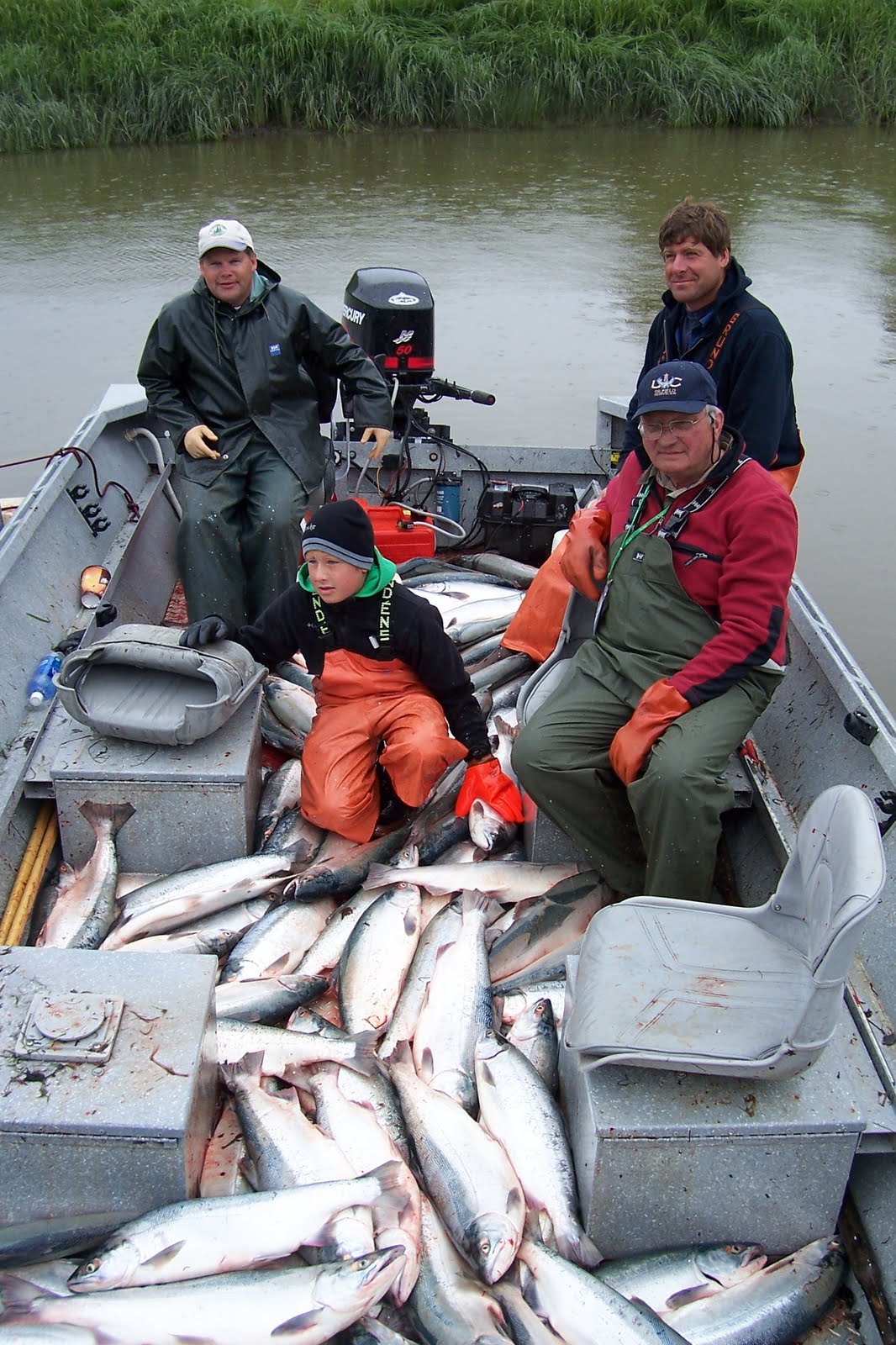
Here's a photo of a boat not exactly being safe. First of all, it looks like they are overweight with just the four men in the boat. On top of that, could you imagine each getting their individual 25 fish limit? That would be 100 red salmon averaging 8 pounds. That's 8oo extra pounds in their boat! I know for a fact that the Coast Guard rating would not support that load.


Quite a few of our sportfishing guests will see me after a day of dipnetting and pooh-pooh the "sport" of dipnetting. They'll say it can't be any fun compared to fighting a salmon on a rod and reel. I usually tell them it's different fun and it's comparing apples to oranges. The thrill of it all for me is holding the net over the side of the boat and waiting for a fish to hit the web. When you feel the jolt, the adrenaline flows and you can't pull the net in fast enough to see what is in there. Is it a red, a pink, a king, a flounder, or dolly varden?


Can't wait until July.....


Monday, April 11, 2011

Harbor Seals

Harbor seals are just one of the many animals you'll find on the Kenai River. It's good and bad when we see seals in the river. If they're in the river that means that there are fish present. That's good. The bad is they are after what we are after and let me tell you they are fish eating machines.
A couple of quick facts about harbor seals. When they're mature they'll be 5-6 feet long and will weigh 180-285 pounds. They're lifespan is 26-35 years.
During the silver season is when we see the most seals. It's been my opinion that when there are fewer fish to be caught in the ocean they move into the rivers because "that is where the fishing is good." A trip doesn't go by that we don't catch a silver salmon that escaped a seal attack. I'm posting a few of the more obvious photos of salmon that have escaped but managed to find our hooks.